
A RARE inflection point
This isn't an AI Upgrade — It's a Full Stack Reinvention

The hype is loud — the signal is quiet.
Frontier AI platforms like OpenAI, Claude, and Grok dominate the public imagination, often carrying expectations that extend well beyond near-term fundamentals.
Beneath this surface-level exuberance, a more consequential shift is quietly underway. Applied and agentic AI — systems embedded directly into workflows, infrastructure, and decision-making — are only now beginning to take shape, and therefore encountering more rational market conditions. Valuations are recalibrating. Capital discipline is returning.
the window between a company's earliest inflection point and the moment the market catches on is where the most meaningful returns are created.
These moments of recalibration have historically marked the most attractive entry points for long-term investors — when technical capability is advancing rapidly, attention is uneven, and the market hasn't yet caught up to what's actually being built.
It's not about chasing the wave, but positioning ahead of the next one — backing companies that will define how AI is operationalized, trusted, and scaled over the coming decade.
a generational platform shift
When technology, economics, and adoption converge.
We are at the front edge of a generational platform shift — comparable to the early days of cloud and mobile, but with far greater economic reach across AI, cybersecurity, and B2B software.
Applied and agentic AI are compressing product development cycles, lowering the cost of experimentation, and enabling small, highly technical teams to build enterprise-grade solutions faster than ever. The advantage flows disproportionately to early-stage companies — where product-market fit and data advantage can compound long before incumbents can respond.
A resetting enterprise buying environment
The enterprise buying environment is quietly resetting in favor of new entrants. Labor constraints, margin pressure, and escalating security risk are forcing organizations to adopt AI-driven automation and security-by-default architecture not as innovation projects, but as operational necessities.
This creates fertile ground for vertical AI and domain-specific SaaS platforms that deeply understand workflow, data, and compliance within a single industry. These companies are not competing on features alone; they are embedding themselves into the economic engine of their customers.
A new phase for cybersecurity
As AI expands the attack surface and accelerates threat velocity, security can no longer be bolted on — it must be native, adaptive, and automated.
Early-stage cyber startups built with AI-first architectures are uniquely positioned to address this shift, while legacy platforms struggle to retrofit decades-old stacks. The result — a rare window where new companies can become system-of-record or system-of-defense providers much earlier in their lifecycle.
Macro tailwinds are aligning
Accessibility | Declining infrastructure costs are lowering the barrier to AI deployment at scale.
Demand | Enterprise-wide AI adoption is creating sustained, compounding demand.
Clarity | Regulatory progress in key sectors is accelerating enterprise decision-making
Prioritization — Renewed focus on productivity is driving budget allocation towards automation
Importantly, this is not a consumer-driven cycle, it's an enterprise-led, budget-backed, and tied directly to ROI — a combination that historically produces durable companies and attractive early-stage entry points for investors.
what many overlook
This isn't happening at one layer — it's happening at every layer, at once.
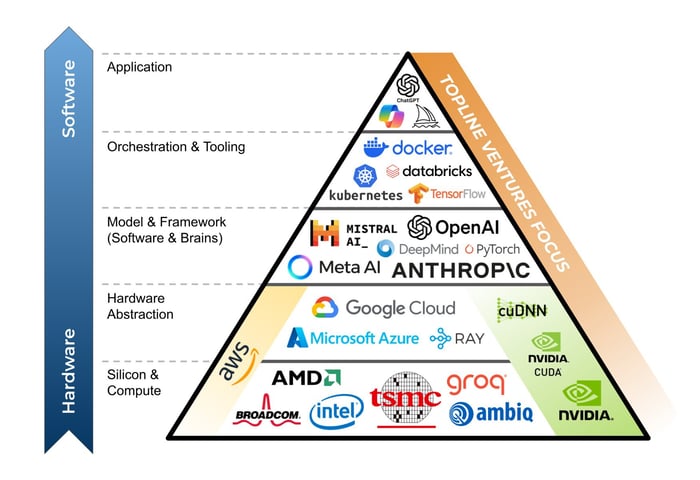
The entire stack is being rebuilt simultaneously — and that's what makes this moment unlike anything we've seen before. Artificial intelligence is no longer confined to the application layer. It's fundamentally reshaping silicon, infrastructure, and software at the same time — each advance compressing the next, collapsing innovation cycles, and opening space for a new generation of startups to move faster than incumbents ever could.
Silicon + Hardware Level
AI has forced a decisive shift from general-purpose CPUs to specialized accelerators. Companies like NVIDIA, AMD, and hyperscaler-designed chips are redefining what performance and economics look like at scale.
Infrastructure Layer
Silicon forced infrastructure to evolve. Cloud providers — AWS, Microsoft Azure, and Google Cloud — are rebuilding data centers, networking, and storage from the ground up to support AI-native workloads. This isn't incremental investment. It's architectural reinvention.
Platform + Application Layer
Infrastructure made a new platform layer possible. AI models and tooling from OpenAI, Anthropic, Databricks, Snowflake, and Hugging Face are no longer optional features — they are becoming the foundational building blocks on which the next generation of enterprise software is being built.
why now matters
A convergence, not a coincidence.
Startup valuations are in check, capital discipline has returned, and the founders rewriting the gloabal AI operating system are making decisions about their earliest partners right now. The condition that have historically produced the most durable early-stage outcomes are aligning — not by accident, but by convergence.
Taken together, this generational platform shift and full-stack disruption point to the same conclusion — the most important companies of the next decade are being built right now.
The window is open — but not indefinitely.
Early-stage participation at this moment offers are asymmetric exposure at the convergence of capability, market readiness, and economic necessity. The applied and agentic Ai wave is only beginning, driven by real demand for efficiency, security, and trust — history suggest the most meaningful returns come to those who recognized the moment early.
Let's talk about what's on the horizon.
Some of the best conversations I've had started with a simple note. If you want to go deeper on what we're building — or if you know someone who should be a part of this — I'd love to hear from you.